Local Guide
Tampa vs. St. Petersburg vs. Clearwater: Where Should You Live?
Compare Tampa, St. Petersburg, and Clearwater by commute, lifestyle, beaches, schools, flood exposure, and the real monthly cost of owning a home.
By Holden Kellerhals, NMLS #2646551St. Petersburg, Florida
Quick Answer
Should you live in Tampa, St. Petersburg, or Clearwater?
Choose Tampa for Tampa-side jobs, airport access, and the widest urban-to-suburban range; St. Petersburg for a concentrated downtown, arts, and bayfront lifestyle; or Clearwater for Gulf access and a central or north Pinellas routine. The best fit depends on your real commute and the property's complete monthly cost.
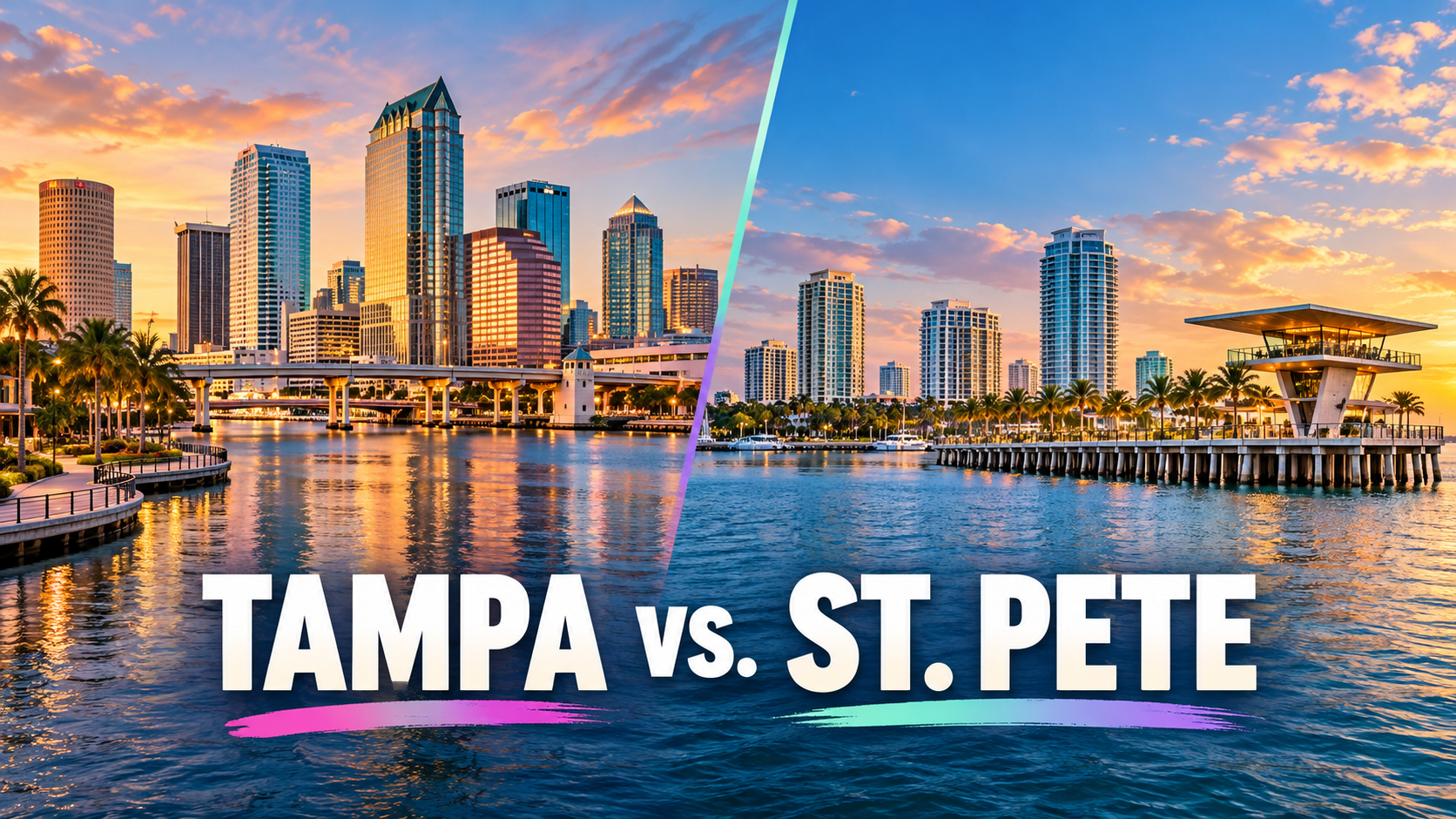
If you want the short answer: choose Tampa when access to major job centers, Tampa International Airport, and a broader mix of urban and suburban housing matters most. Choose St. Petersburg when you want a compact, active downtown with arts, restaurants, and a public waterfront woven into daily life. Choose Clearwater when Gulf access, central Pinellas convenience, and a more spread-out residential pattern fit your routine.
But there is no universal winner in the Tampa vs. St. Petersburg vs. Clearwater debate. The right answer depends less on postcard views and more on where you will work, how often you will cross a bridge, what type of home you want, and what the complete monthly payment looks like after taxes, insurance, flood coverage, and association fees.
Tampa vs. St. Petersburg vs. Clearwater at a glance
Tampa
- County: Hillsborough County.
- Strongest practical fit: Tampa-side employment, frequent flights, and buyers who want the widest urban-to-suburban search area.
- Everyday geography: East side of Tampa Bay with a large city footprint.
- Signature public space: The Tampa Riverwalk and its connected downtown attractions.
- Transit: HART buses, plus the TECO Line Streetcar in the downtown, Channel District, and Ybor City corridor.
- Main tradeoff: A Tampa mailing address can still place you a long drive from the version of Tampa you visit most often.
St. Petersburg
- County: Pinellas County.
- Strongest practical fit: A downtown-centered routine with arts, dining, bayfront recreation, and access to south Pinellas.
- Everyday geography: A peninsula location with Tampa Bay to the east and Gulf beaches to the west.
- Signature public space: The downtown waterfront and 26-acre St. Pete Pier District.
- Transit: PSTA service, including the SunRunner connection between downtown and St. Pete Beach.
- Main tradeoff: A Tampa-side job can make the Howard Frankland Bridge part of your regular week.
Clearwater
- County: Pinellas County.
- Strongest practical fit: Gulf access and a routine centered on north or central Pinellas.
- Everyday geography: Downtown, Clearwater Beach, and many residential areas are separate destinations.
- Signature public space: Downtown's 19-acre Coachman Park, with Clearwater Beach across the causeway.
- Transit: PSTA buses and trolleys, with ferry options connecting downtown, Clearwater Beach, and Dunedin.
- Main tradeoff: Beach access is excellent, but the city is more dispersed and barrier-island traffic can affect the trip.
City scale figures are the U.S. Census Bureau’s July 1, 2025 estimates for Tampa, St. Petersburg, and Clearwater. They are useful context—not a forecast of what any particular neighborhood will feel like.
Start with your weekly map, not your weekend itinerary
Relocating buyers often tour Tampa Bay like visitors: downtown dinner, beach afternoon, sunset photo. That is a fine way to fall for the region and a terrible way to test a Tuesday.
Before comparing homes, put these five pins on a map:
- Your workplace or most frequent client location.
- The airport you expect to use.
- School, childcare, or recurring appointments.
- The grocery store, gym, or activity you will visit several times a week.
- The people or places you want nearby.
Then test the routes at the times you would actually drive them. Tampa Bay is connected by bridges and causeways, but water still makes the region directional. St. Petersburg and Tampa connect primarily through I-275 and the Howard Frankland Bridge. Clearwater and Tampa connect naturally through SR 60 and the Courtney Campbell Causeway. A route that looks reasonable at noon may feel very different during a weekday commute or a beach weekend.
FDOT opened express lanes across the new Howard Frankland Bridge in 2026, and the agency still lists associated construction with an estimated late-2026 completion. That improves the corridor, but it does not make a cross-bay commute irrelevant; express lanes are tolled and traffic remains situational. Check the current FDOT Tampa Bay project page before relying on an old commute estimate.
Living in Tampa: access, variety, and a larger playing field
Tampa is the most logical starting point for many buyers whose work and travel pull them east of the bay. Tampa International Airport sits about five miles west of downtown, according to the airport’s official directions page. Downtown, Westshore, the airport area, the university and medical corridors, and the I-4 connection toward Central Florida all make Tampa useful for people whose week has several destinations.
Downtown and the Channel District feel different from South Tampa, Seminole Heights, West Tampa, New Tampa, or communities beyond the city limit. The Riverwalk connects parks, museums, and downtown destinations, but “living in Tampa” may also mean a quieter, car-oriented residential area. The city’s Riverwalk guide shows the urban-core experience, not the entire city.
Tampa tends to fit buyers who want:
- Shorter access to Tampa-side employers or Tampa International Airport.
- More choice between condos, townhomes, older established neighborhoods, and newer development across a broad search area.
- Downtown sports, events, museums, and dining without crossing the bay.
- Direct access to I-4 for regular trips east.
The tradeoff is geography. Tampa is physically much larger than St. Petersburg or Clearwater. A listing can have “Tampa” in the mailing address and still be nowhere near the version of Tampa you toured. Compare the actual address with your routine rather than comparing city names.
Transit can help in specific corridors, but it is not a substitute for testing your entire trip. HART serves Hillsborough County, while the TECO Line Streetcar connects Ybor City, the Channel District, and downtown. If car-light living is a goal, verify the precise home-to-destination route and service schedule before you buy.
Living in St. Petersburg: a concentrated downtown and bayfront rhythm
St. Petersburg’s strongest distinction is how much activity is concentrated around downtown and the waterfront. The St. Pete Pier District covers 26 acres and includes public art, restaurants, family spaces, recreation, and a fishing deck, according to the official Pier guide. Central Avenue and nearby districts add restaurants, shops, galleries, and nightlife to the equation.
That makes St. Pete appealing when your week centers on downtown and south Pinellas. The SunRunner links downtown St. Petersburg, the Central Avenue business districts, Pasadena, and St. Pete Beach; traffic can affect timing. Review the current SunRunner route and schedule for the address you are considering.
St. Petersburg tends to fit buyers who want:
- A downtown-centered lifestyle with waterfront parks, arts, dining, and events close together.
- Access to both Tampa Bay on the east side of the peninsula and Gulf beaches to the west.
- Established neighborhoods near an active urban core.
- A PSTA and SunRunner route that works for their specific routine.
The tradeoff is the peninsula. If your job, clients, family, or medical appointments are routinely in Tampa, you are committing to a bridge crossing. Some people happily make that trade; others discover that the city they enjoy most on Saturday is not the one that makes Monday easiest.
Housing type also matters. St. Petersburg has single-family homes, townhomes, and condos, including buildings where association finances, reserves, insurance, inspections, and assessments can materially affect the ownership picture. A beautiful unit and an affordable-looking list price are only the beginning of the analysis.
Living in Clearwater: Gulf access without pretending the whole city is the beach
Clearwater is often reduced to Clearwater Beach, but that shortcut creates bad relocation decisions. Clearwater Beach is on a barrier island at the western end of SR 60. Downtown Clearwater sits east of the harbor, and the city’s residential areas spread farther inland and north–south through central Pinellas.
That distinction can be a strength. Buyers can prioritize beach access without living directly on the barrier island, or choose a location that works for north and central Pinellas employment. Downtown has its own waterfront identity: the city describes Coachman Park as a 19-acre park beside Clearwater Harbor Marina with green space, a music venue, playground, splash pad, and promenade. The city’s Clearwater Beach guide shows the separate beach experience across the Memorial Causeway.
Clearwater tends to fit buyers who want:
- Easier access to Clearwater Beach and the north/central Pinellas coast.
- A location that can serve multiple Pinellas destinations without living in downtown St. Pete.
- Residential choices beyond the tourist-facing beach corridor.
- Access to St. Pete–Clearwater International Airport or the SR 60 route toward Tampa International Airport.
The tradeoff is that Clearwater is less concentrated. Your home, beach, downtown event, and workplace may be in different directions. Traffic and parking near the beach change with season, weather, and events. PSTA routes, trolleys, and the ferry can help, but check current service. The city lists ferry, trolley, bus, bike, and rideshare options for downtown and Coachman Park.
The home price is not the monthly cost
A city comparison becomes financially useful only when it reaches the property level. Two homes at the same price can carry very different monthly costs because of:
- Homeowners insurance.
- Wind and flood coverage.
- Property taxes after a change of ownership.
- Condo or homeowners association dues.
- Special assessments or reserve funding.
- Maintenance tied to age, roof, systems, or coastal exposure.
- Toll and commuting costs.
Do not use the seller’s current property-tax bill as your future estimate. The Pinellas County Property Appraiser specifically warns buyers not to rely on the seller’s taxes after a change of ownership and provides a new-owner tax estimator. Hillsborough’s Property Appraiser also provides a property search and tax estimator. Florida’s Department of Revenue explains that eligible permanent residents may receive homestead benefits, but eligibility and savings are property-specific and determined by the county property appraiser. Review the state’s current homestead guidance.
This is where financing strategy belongs in the relocation decision. A comfortable purchase price is not just what a lender may approve. It is the range that leaves room for the insurance quote, taxes under new ownership, flood coverage if applicable, association obligations, and the life you want after closing.
Flood zones and evacuation zones are different
In Tampa Bay, “How close is it to the water?” is not a sufficient risk check. A flood zone is used to describe flood risk and can affect insurance and lending requirements. An evacuation zone is used by local officials for storm-surge evacuation planning. A home can be in one without being in the other.
Hillsborough County explains the distinction in its flood-zone and evacuation-zone guide. Pinellas County gives the same warning and recommends checking both through its Flood Map Service Center and evacuation tools.
For any serious candidate property:
- Look up the FEMA flood designation.
- Check the county evacuation zone.
- Get property-specific insurance quotes during your due-diligence period.
- Ask for available elevation certificates, claim history, permits, and relevant association documents.
- Confirm requirements with your insurer and lender instead of relying on a listing description.
Schools: compare addresses, not city reputations
Tampa is primarily served by Hillsborough County Public Schools. St. Petersburg and Clearwater are served by Pinellas County Schools. Attendance zones, choice programs, transportation, and boundaries can change, so broad claims that one city has “better schools” are neither useful nor reliable.
Use the exact address. Hillsborough’s school and bus locator asks users to verify results with the school because attendance and transportation information can change. Pinellas provides an address-based School Zone Locator. Families should also check program eligibility, application windows, transportation, and childcare logistics directly with the district.
A six-step way to choose confidently
Use this framework before making an offer:
- Choose your anchor. Identify the place you must reach most often.
- Set a commute boundary. Decide the maximum drive you will accept on a normal weekday, then test it live.
- Compare the full payment. Use realistic taxes, insurance, flood coverage, HOA or condo fees, and mortgage terms.
- Check the property, not the ZIP code. Review flood, evacuation, insurance, building, and association details for the address.
- Verify schools and services. Use current district and utility tools rather than third-party summaries.
- Visit like a resident. Make the drive, buy groceries, park, walk the block after dark, and repeat during rain or rush hour if possible.
So, where should you live?
Choose Tampa if your center of gravity is Tampa-side work, frequent flights, or a wider urban-to-suburban home search.
Choose St. Petersburg if your center of gravity is downtown St. Pete, the bayfront, arts and dining, or south Pinellas—and you are comfortable with the bridge whenever life pulls you to Tampa.
Choose Clearwater if your center of gravity is central or north Pinellas, Gulf access, or a residential routine that does not depend on living in a single dense downtown.
If two cities still look equally good, let the numbers break the tie. I can help you compare sample homes using an estimated complete monthly payment—not just the list price—so you can see what each location does to your budget before you get attached to a kitchen.
Frequently Asked Questions
- Is Tampa or St. Petersburg better for commuting?
- It depends on the destination. Tampa is usually more direct for Tampa-side employers and Tampa International Airport. St. Petersburg is more practical for a routine concentrated in south Pinellas. Test any Howard Frankland Bridge trip during your real commute window.
- Is Clearwater the same as Clearwater Beach?
- No. Clearwater Beach is on a barrier island west of Clearwater Harbor. Downtown Clearwater and many residential areas are on the mainland, with different routes, flood exposure, parking patterns, and everyday feel.
- Which city is the most walkable?
- Downtown St. Petersburg has the most concentrated combination of waterfront, restaurants, arts, and daily destinations among the three urban cores. Parts of downtown Tampa and pockets of downtown Clearwater and Clearwater Beach are also walkable. Test the exact address against the destinations you use.
- Which city has the lowest cost of living?
- There is no dependable citywide answer for a homebuyer. Property taxes after purchase, insurance, flood coverage, association fees, maintenance, tolls, and commuting can reverse the apparent price difference. Compare specific properties using the same financing assumptions.
- Do I need flood insurance in Tampa, St. Petersburg, or Clearwater?
- It depends on the property, flood zone, lender, and insurance arrangement. Check the address, obtain a current quote, and confirm requirements with your lender and insurer.
Sources
- U.S. Census Bureau QuickFacts — Tampa (opens in a new tab)https://www.census.gov/quickfacts/fact/table/tampacityflorida/PST045225
- U.S. Census Bureau QuickFacts — St. Petersburg (opens in a new tab)https://www.census.gov/quickfacts/fact/table/stpetersburgcityflorida/IPE120222
- U.S. Census Bureau QuickFacts — Clearwater (opens in a new tab)https://www.census.gov/quickfacts/fact/table/clearwatercityflorida/HCN010222
- Tampa International Airport — Directions (opens in a new tab)https://www.tampaairport.com/directions
- PSTA SunRunner (opens in a new tab)https://psta.net/routes/sunrunner/
- City of Clearwater — Clearwater Beach (opens in a new tab)https://www.myclearwater.com/Visit-Clearwater-Beach
- Hillsborough County — Evacuation Zones vs. Flood Zones (opens in a new tab)https://hcfl.gov/residents/public-safety/flooding/evacuation-zones-vs-flood-zones
- Pinellas County — Flood Information (opens in a new tab)https://pinellas.gov/flood-information/
- Florida Department of Revenue — Property Tax Exemptions (opens in a new tab)https://floridarevenue.com/property/Pages/Taxpayers_Exemptions.aspx

About the author
Holden Kellerhals
Mortgage Loan Originator · NEXA Lending · NMLS #2646551
Have a question about your own situation?
Creative strategies for real life. Let's make it work.