Local Guide
Moving to Tampa Bay: The Complete 90-Day Relocation Checklist
Planning a move to Tampa Bay? Use this practical 90-day checklist to compare communities, prepare your housing budget, manage utilities, and avoid relocation surprises.
By Holden Kellerhals, NMLS #2646551St. Petersburg, Florida
Quick Answer
What should I do during the 90 days before moving to Tampa Bay?
Start by defining your preferred communities and complete housing budget, then work through financing, property research, insurance, taxes, utilities, moving logistics, and your first-month tasks. Starting about 90 days ahead gives you time to verify the details without leaving everything for the final week.
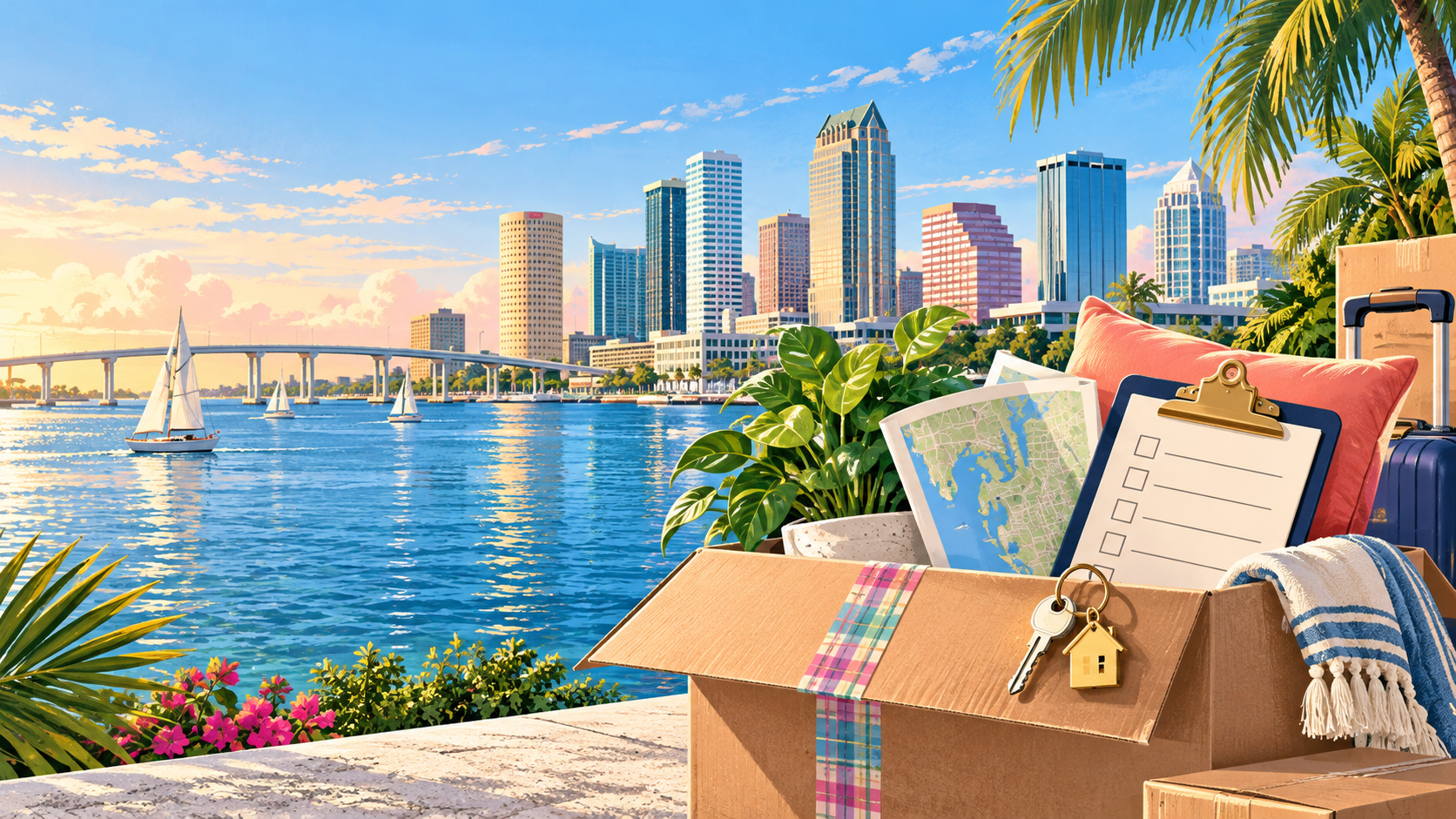
Moving to Tampa Bay involves more than hiring movers and forwarding your mail.
You’re choosing between different cities, counties, commute patterns, school systems, flood considerations, utility providers, insurance conditions, and housing costs—all within one region that looks deceptively compact on a map.
This 90-day checklist will help you organize the move without trying to solve everything during the final week.
First, decide what “Tampa Bay” means for your move
Tampa Bay is a region, not one interchangeable city.
Tampa, St. Petersburg, Clearwater, Brandon, Riverview, Wesley Chapel, Palm Harbor, Dunedin, Safety Harbor, and the beach communities can offer dramatically different daily experiences.
Before comparing houses or apartments, identify the parts of your routine that matter most:
- Where will you work?
- How often will you commute?
- Do you need access to Tampa International Airport?
- Are schools or childcare a priority?
- Do you want walkability, a larger yard, newer construction, nightlife, or water access?
- How often do you realistically expect to visit the beach?
- Are you comfortable crossing a bridge during your regular commute?
That last question matters more than many newcomers expect. Two locations may appear close on a map while producing very different commute experiences.
90–61 days before your move
1. Build your Tampa Bay lifestyle map
Start with the places you expect to visit every week—not a list of attractive neighborhoods.
Plot your workplace, schools, childcare, family, medical providers, airport access, and preferred activities. Then identify communities that keep the most important trips manageable.
A neighborhood should work on an ordinary Tuesday, not just during a sunny weekend visit.
2. Calculate your complete housing budget
If you plan to buy, the purchase price is only the beginning.
Your monthly housing budget may include:
- Principal and interest
- Property taxes
- Homeowners insurance
- Flood insurance
- HOA or condominium fees
- Community Development District fees
- Utilities
- Maintenance
- Commuting costs
Insurance, taxes, association fees, and flood considerations can materially change what feels comfortable from one property to another.
Instead of asking, “What price can I qualify for?” ask, “What complete monthly payment allows me to live comfortably after I move?”
That is a much better starting point.
3. Get mortgage-ready before touring seriously
If buying is part of the plan, have the financing conversation early.
A useful preapproval should help you understand:
- Your estimated comfortable payment range
- The funds you may need for closing
- Which documents will be required
- How your employment or relocation affects qualification
- Whether proceeds from another home are involved
- Which loan options fit your situation
- How taxes, insurance, HOA fees, or CDD fees affect the numbers
Avoid making major financial changes during this period without discussing them with your mortgage professional. Opening new credit, changing jobs, moving money between accounts, or making a large purchase can create unnecessary complications.
4. Compare areas by routine, not reputation
Create a shortlist of three to five communities and test each one against your real life.
Compare:
- Morning and evening drive times
- Grocery and healthcare access
- Walkability
- Housing age and maintenance
- Insurance considerations
- School assignments
- Parks and recreation
- Airport access
- Weekend traffic
- HOA or condominium restrictions
“Best neighborhood” lists are rarely useful unless the writer knows what you value.
60–31 days before your move
5. Perform address-level research
Once you begin considering specific properties, broad neighborhood research is no longer enough.
Check each address for:
- FEMA flood-zone information
- Local evacuation-zone information
- Insurance availability
- Estimated property taxes after purchase
- HOA, condominium, or CDD obligations
- Utility providers
- Internet availability
- School assignment
- Permits or property-specific concerns
FEMA’s Map Service Center is the official federal source for flood-hazard maps. Remember that a flood zone and an evacuation zone answer different questions, so review both.
Do not rely solely on a listing description or a third-party map when the information can affect your budget or safety.
6. Request property-specific insurance guidance
Florida insurance should not be treated as a last-minute closing task.
The property’s roof, age, construction, location, wind-mitigation features, prior claims, and inspection results may all influence coverage or cost.
Request insurance guidance before you become emotionally committed to a property. The least expensive house on your shortlist is not necessarily the least expensive one to own.
7. Plan your property-tax expectations
A seller’s current tax bill may not represent what you will pay after purchasing the property.
Florida homeowners who make a property their permanent residence may qualify for a homestead exemption that can reduce taxable value by as much as $50,000. Applications go through the property appraiser in the county where the home is located. Review the current rules through the Florida Department of Revenue and the appropriate county property appraiser.
For budgeting purposes, use a property-tax estimate based on your expected purchase—not simply the seller’s existing bill.
8. Reserve movers and create a weather backup plan
Summer moves in Tampa Bay can involve heat, humidity, and fast-moving afternoon storms.
When booking movers:
- Ask how weather delays are handled
- Confirm whether the estimate is binding
- Verify insurance coverage
- Photograph valuable items
- Keep essential documents with you
- Schedule earlier in the day when possible
- Avoid placing medications or heat-sensitive items in a moving truck
Keep water, sunscreen, towels, rain protection, and a change of clothes accessible.
30–14 days before your move
9. Confirm closing and moving funds
If you are purchasing a home, confirm:
- Your final funds-to-close process
- Acceptable transfer methods
- Identification requirements
- Homeowners and flood-insurance documentation
- Closing location or remote-closing instructions
- Final walkthrough timing
Wire fraud is real. Verify instructions through a trusted phone number before transferring money, and never rely on an unexpected email that changes wiring information.
10. Identify the correct utility providers
Utility service can vary by address—even within the same general area.
For example, the City of Tampa notes that some properties may receive water, wastewater, and solid-waste services from different providers. Its current guidance recommends allowing up to five business days to process a start-service request. Use the city’s utility service lookup and start-service information if the property is within or near Tampa.
Confirm:
- Electricity
- Water
- Wastewater
- Trash and recycling
- Gas, if applicable
- Internet
- Security service
- Lawn or pool service
Do not assume the provider based solely on the mailing address.
11. Review your internet options before move-in day
Provider availability and connection quality can vary by street, building, and unit.
If you work remotely, verify the exact address rather than accepting a general coverage map. Ask whether the property has fiber service, whether equipment must be shipped, and whether a technician appointment is required.
12. Create an arrival folder
Keep one physical or digital folder containing:
- Lease or closing documents
- Identification
- Insurance documents
- Utility confirmations
- Moving-company information
- School and medical records
- Pet vaccination records
- Medication information
- Important contact numbers
- Receipts related to the move
You should be able to access this folder without opening a moving box.
The final two weeks
13. Confirm the property is ready
Before arrival, verify:
- The electricity and water will be active
- Internet installation is scheduled
- You have keys, access codes, and parking information
- Elevator reservations are confirmed
- HOA or condominium move-in requirements are satisfied
- Pets are permitted and registered if required
- Large deliveries can access the property
Condominium buildings may limit moving hours or require proof of insurance from the moving company.
14. Prepare a first-night kit
Pack separately:
- Bedding
- Towels
- Toiletries
- Chargers
- Medications
- Cleaning supplies
- Basic tools
- Pet supplies
- Coffee
- Important documents
- Clothes for two days
- Rain protection
Your first evening should not depend on locating the box labeled “miscellaneous kitchen.”
15. Save essential local information
Before arrival, identify:
- The nearest urgent-care facility
- The nearest emergency veterinarian
- Your evacuation zone
- Your planned evacuation route
- Local non-emergency numbers
- Your utility emergency contacts
- Your insurance claim contacts
If you move during hurricane season, assemble a basic storm kit immediately instead of waiting until a storm enters the forecast.
Your first 30 days in Tampa Bay
16. Complete Florida residency tasks
Review current requirements for:
- Driver’s licenses
- Vehicle titles and registration
- Voter registration
- Insurance
- Mailing-address updates
- Professional licenses, if applicable
Use the Florida Department of Highway Safety and Motor Vehicles for current licensing and vehicle requirements rather than relying on a relocation blog’s deadline.
17. Apply for homestead exemption if eligible
If the new home is your permanent Florida residence, review homestead-exemption eligibility and filing requirements with your county property appraiser.
Do not assume the previous owner’s exemption transfers to you.
18. Test your real commute
Drive your normal route during the hours you will actually travel. This will help you identify realistic departure times, toll-road preferences, and alternate routes.
19. Establish three local routines
Choose:
- One nearby grocery store
- One park, coffee shop, or recreation spot
- One dependable healthcare or service provider
Feeling settled usually comes from building a routine, not finishing every moving box.
The Tampa Bay relocation checklist at a glance
Before moving:
- Define your weekly lifestyle map
- Establish a complete housing budget
- Prepare financing early
- Compare communities by daily routine
- Research flood and evacuation information
- Request property-specific insurance guidance
- Estimate post-purchase property taxes
- Confirm HOA, condominium, and CDD obligations
- Identify address-specific utility providers
- Schedule movers and internet service
- Create an arrival folder
- Prepare a storm and first-night kit
After moving:
- Complete Florida residency requirements
- Review homestead-exemption eligibility
- Test your real commute
- Update insurance and official records
- Establish your local routine
Planning a move to Tampa Bay?
A productive mortgage conversation should give you more than a maximum purchase price. It should help you understand how the payment, insurance, property taxes, association fees, and your broader financial goals fit together.
If Tampa Bay is on your radar, I’m happy to help you work through the numbers and build a plan around your actual life.
Sources
- FEMA Map Service Center (opens in a new tab)https://msc.fema.gov/portal/home
- Florida Department of Revenue — Property Tax Exemptions (opens in a new tab)https://floridarevenue.com/property/Pages/Taxpayers_Exemptions.aspx
- City of Tampa — Start Utility Service (opens in a new tab)https://www.tampa.gov/city-of-tampa-utilities/start-service
- Florida Department of Highway Safety and Motor Vehicles (opens in a new tab)https://www.flhsmv.gov/

About the author
Holden Kellerhals
Mortgage Loan Originator · NEXA Lending · NMLS #2646551
Have a question about your own situation?
Creative strategies for real life. Let's make it work.